Women and related knowledge
From radioactivity to the double helix of DNA, and the first computer algorithms, Marie Curie, Rosalind Franklin, and Ada Lovelace each transformed our understanding of the world. Through books and works honoring them, their journeys reveal the strength, rigor, and vision of women long overshadowed by history, yet whose legacy continues to inspire modern science.
Marie Curie
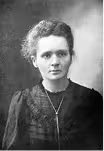
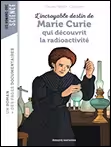
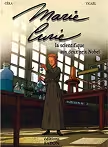
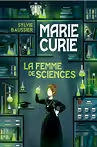
Marie Curie (1867-1934) was a Franco-Polish physicist and chemist, a pioneer of radioactivity, and the first woman to receive a Nobel Prize, which she won twice in physics and chemistry. Her work led to the discovery of polonium and radium and paved the way for radiotherapy. Her extraordinary life is recounted in several works: The Incredible Destiny of Marie Curie Who Discovered Radioactivity by Pascale Hédelin describes her journey from childhood in Poland to her groundbreaking research and fight for scientific recognition. Marie Curie, the Scientist with Two Nobel Prizes by Céka details her daily life as a researcher and the challenges related to her gender. For young readers, Marie Curie: The Woman of Science by Sylvie Baussier makes her story accessible and inspiring, highlighting her courage, curiosity, and lasting impact on science and society. These works show how Marie Curie embodies both scientific genius and perseverance against prejudice.
Rosalind Franklin
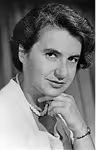
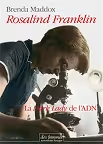
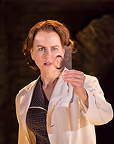
Rosalind Franklin (1920-1958) was a British biologist and crystallographer whose research was crucial to uncovering the double helix structure of DNA. Despite her central role, her contributions were often underestimated. Her biography, Rosalind Franklin: The Dark Lady of DNA by Brenda Maddox, explores both her scientific career, personality, and the injustices she faced in the male-dominated academic world of her time. She is also featured in Anna Ziegler's play Photograph 51, which dramatizes her professional struggles, highlighting her talent and tenacity. These works present Rosalind Franklin as a symbol of female scientific excellence and the fight for recognition and equality, inspiring many young scientists to pursue their ambitions despite obstacles.
Ada Lovelace
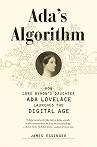
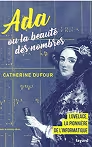
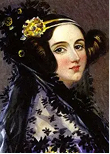
Ada Lovelace (1815-1852), daughter of poet Lord Byron, is considered the first computer programmer for her work on Charles Babbage's Analytical Engine. She understood the potential of this machine beyond mere calculation and wrote the first algorithm intended to be executed by a machine, making her a key figure in modern computing. Several books detail her life and genius: Ada's Algorithm by James Essinger recounts how her curiosity and mathematical mind enabled fundamental advances in programming. Ada or The Beauty of Numbers by Catherine Dufour explores her scientific contributions and intellectual legacy. These books celebrate her visionary role and ability to transform abstract ideas into concrete innovations, making her an inspiration for future generations.