

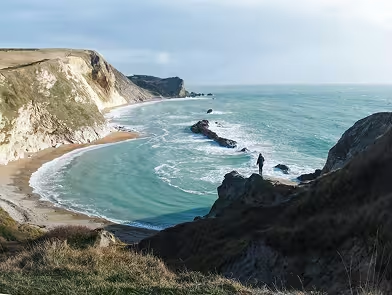
Beneath the Cliffs of Dorset
At the origin of decisive discoveries on fossilized marine reptiles, Mary Anning revolutionized science without ever receiving the recognition she deserved. Her works, often published under other names, reveal a brilliance long rendered invisible.
Mary Anning's Discoveries
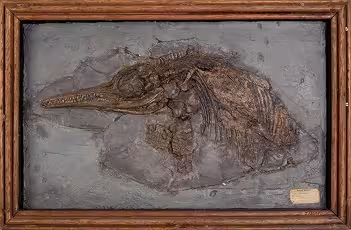
Mary Anning made several major discoveries in paleontology during the early 19th century. At just 12 years old, she and her brother discovered the first complete ichthyosaur skeleton on the beaches of Dorset. Yet the scientific publication was signed by the British geologist Henry De la Beche, who benefited from her observations without crediting her.
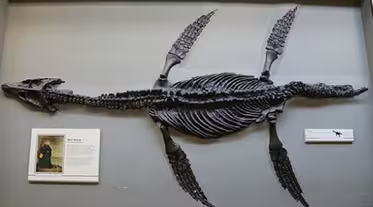
In 1823, she unearthed the first complete plesiosaur specimen, presented to the Geological Society of London by British paleontologist William Conybeare, who nonetheless dismissed her as merely an amateur despite her expertise.
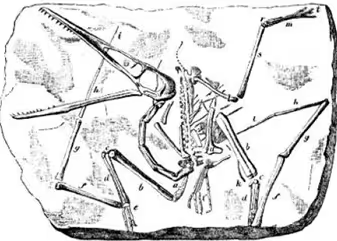
In 1828, she identified a fossilized pterodactyl the first specimen discovered outside Germany, but the find was officially reported by British paleontologist William Buckland.
She also discovered fossils such as belemnites with their fossilized ink sacs, enriching the understanding of Jurassic marine life. Her research focused on the Jurassic Coast of Dorset, a region especially rich in fossils dating from 201 to 145 million years ago. Each fossil was carefully extracted, prepared, and studied, providing specimens of remarkable scientific quality.
Impact on the Scientific and Cultural World
These discoveries had a profound impact on science and the understanding of natural history. They provided substantial evidence for the extinction of species, challenging the prevailing belief in the immutability of living creations. The fossils supported Georges Cuvier's research on species extinction and helped establish paleontology as a rigorous scientific discipline. They also enhanced comprehension of the past diversity of marine life and paved the way for Charles Darwin's theory of evolution. Despite initial controversy and skepticism, Anning's discoveries gradually transformed scientific and cultural perceptions of Earth's history. Today, they continue to influence research and museum studies, highlighting the importance of meticulous observation and systematic study of fossils in understanding the evolution of species and ancient ecosystems.