

When science comes to life
From Mary Anning, whose discoveries laid the foundations of modern paleontology, to Claire Dearing, operations manager of the Jurassic World park, emerges the story of women's struggle to exist and be recognized in a scientific and cultural world long dominated by men.
Synopsis
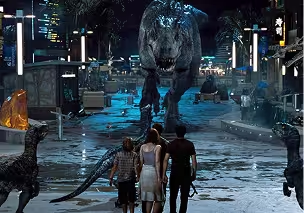
Released in 2015 and directed by Colin Trevorrow, Jurassic World takes us back to Isla Nublar, twenty-two years after the events of Jurassic Park. A massive dinosaur-themed amusement park opens its doors to the public under the name Jurassic World. Claire Dearing is the island’s operations manager. To attract more visitors, her team decides to create a new hybrid dinosaur: the Indominus rex, an intelligent and fearsome creature. But the experiment goes wrong when the monster escapes its enclosure, causing panic and destruction on the island. Facing this crisis, Claire turns to Owen Grady, a velociraptor trainer, for help in stopping the creature. Together, they must show courage and careful thinking to save the visitors and regain control of the park.
Claire Dearing's Role in Jurassic World

Claire Dearing plays a central role in the daily management of Jurassic World as operations manager. Organized and methodical, she oversees security and makes key decisions to ensure the park runs smoothly. When the Indominus rex experience. Despite his initiative, Claire retains authority and remains a major figure in coordinating efforts to save the park and its visitors.
Mary Anning's Research and Its Link to Jurassic World
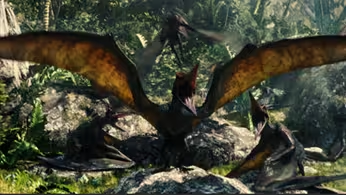
Mary Anning revealed fascinating creatures to the world, such as the ichthyosaur, plesiosaur, and pterosaur, through her research on the Dorset coast. These fossils provided fundamental knowledge about prehistoric animals and their anatomy. Jurassic World draws direct inspiration from such paleontological work. The cloned dinosaurs in the park rely on discoveries like those made by Mary Anning. Without her pioneering research, the idea of a park filled with prehistoric creatures would have been unimaginable.
The Evolution of Women's Role in Science
Mary Anning worked in a context where women were often ignored or ridiculed, and her work was sometimes attributed to men. Today, Claire Dearing represents significant progress: she holds a respected leadership position, makes important decisions, and is recognized for her skills. The contrast between Mary and Claire illustrates the path women have traveled in science and leadership—from near invisibility to positions of power and respect.
Associated film/series
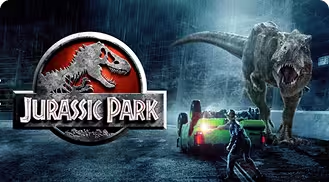
Jurassic Parc (1993)
Jurassic Park tells the story of a billionaire who recreates dinosaurs using fossil DNA on a remote island to create a theme park. But the creatures, unpredictable and powerful, quickly escape control. The film blends adventure and suspense while emphasizing the importance of science and the preservation of extinct species.
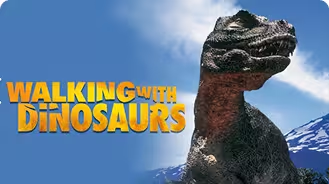
Walking with Dinosaurs (1999)
Walking with Dinosaurs is a groundbreaking documentary series that recreates prehistoric life using realistic special effects and reliable scientific data. It immerses viewers in the world of dinosaurs, illustrating their behavior and environment, and inspires scientific curiosity.
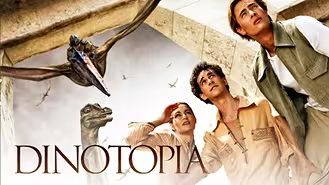
Dinotopia (2002)
Dinotopia follows two brothers stranded on a mysterious island where humans and dinosaurs coexist peacefully. The series combines adventure, exploration, and scientific discoveries within an imaginary prehistoric world.
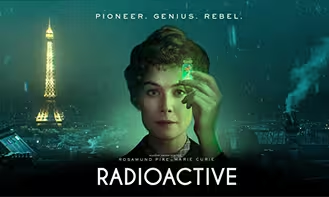
Radioactive (2019)
Radioactive traces the life of Marie Curie, her revolutionary discoveries, and her struggle for recognition in a male-dominated scientific world. She embodies female perseverance in the face of exclusion and doubt, proving that great discoveries can come from those society tries to marginalize.
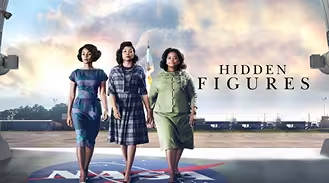
Hidden Figures (2016)
Hidden Figures tells the true story of three African-American female mathematicians working at NASA, whose calculations were crucial to space missions. These women had to fight for their skills to be recognized.
Picture a Scientist (2020)
A documentary about inequalities and discrimination faced by women scientists today, featuring real testimonies from researchers. This film highlights the ongoing obstacles in the scientific field, continuing the fight initiated by pioneering women in science.