

Geology and Archaeology: a scientifique alliance
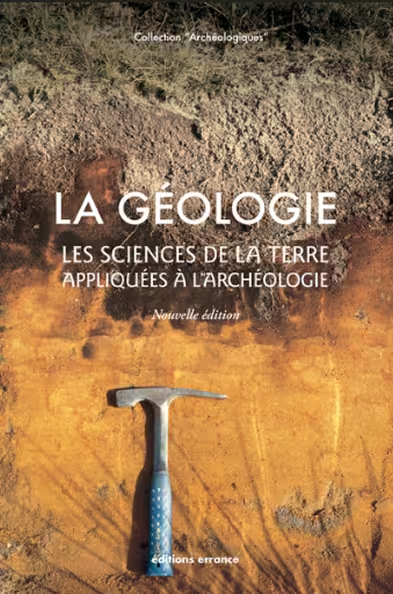
The book shows how geology supports archaeology through techniques like rock analysis and object dating. These methods help to better understand the age and context of archaeological discoveries, thereby improving their interpretation.
Summary
The book Geology, Earth Sciences Applied to Archaeology (Éditions Errance, 2022) by Jean-Paul Bravard explores the key role Earth sciences play in archaeological research. It presents various applications of geology, such as material identification through petrography and petrochemistry, landscape analysis and evolution via geomorphology and sedimentology, and the study of soils and archaeological deposits through pedology and micromorphology. The book also includes sections on specific topics like karstology, marble identification, and issues related to archaeological deposits, notably "black earth." This work offers a comprehensive overview of geological methods that enhance the understanding of archaeological contexts, enriching the archaeology discipline with tools and concepts from Earth sciences.
Interpretation
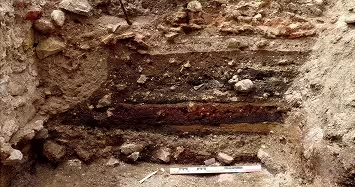
While working on the Dorset cliffs in the early 19th century, Mary Anning observed the arrangement of sedimentary rock layers and the position of fossils they contained. Her discoveries of ichthyosaurs, plesiosaurs, and pterodactyls helped illustrate the principle of superposition, which states that in an undisturbed sedimentary sequence, the oldest layers lie beneath the younger ones. This principle allowed fossils to be classified according to their order of appearance and served as the basis for the relative dating of geological formations. According to the book, this stratigraphic method gradually improved with the introduction of more precise techniques such as thermoluminescence, X-ray diffraction, and absolute dating through radioisotopes. These modern approaches now allow scientists to determine not only the sequence of layers but also their exact age, marking a significant evolution from early field observations to today's scientific tools.
Excerpt
"It is no longer uncommon today to see chemical analyses of major or trace elements, even isotopes, of objects and their components, which either characterize the materials, identify their source, or determine their age. In this sense, physico-chemical analyses are powerful means to reintegrate objects into their history and into History itself. Rather than performing a large number of measurements, often made more or less blindly and of average quality, it is better to prioritize a small number.”